What happened
CMS’s proposed 2027 Hospital Outpatient Prospective Payment System rule would reduce Medicare reimbursement for 340B drugs from average sales price plus 6% to average sales price minus 33.4%, a 37% reduction, according to KFF Health News. CMS said the proposal is intended to better align reimbursement with hospitals’ acquisition costs and based the reduction on a 340B drug acquisition cost survey completed by hospitals in early 2026. If finalized, the change would take effect January 1, 2027.
CMS estimated the policy would reduce Medicare spending on 340B drugs by $4.85 billion in 2027, while increasing spending on non-drug outpatient services by the same amount under OPPS budget neutrality. The agency therefore proposed an 8.44% across-the-board increase in payments for non-drug outpatient services. KFF reported that Medicare beneficiaries who use 340B drugs would save an estimated $1.15 billion in total in 2027 through lower cost sharing, while cost sharing for non-drug outpatient hospital services would rise.
The proposal revives an earlier CMS effort implemented in 2018 that the Supreme Court overturned in 2022 because the agency had not first conducted a cost acquisition survey.
Why it matters
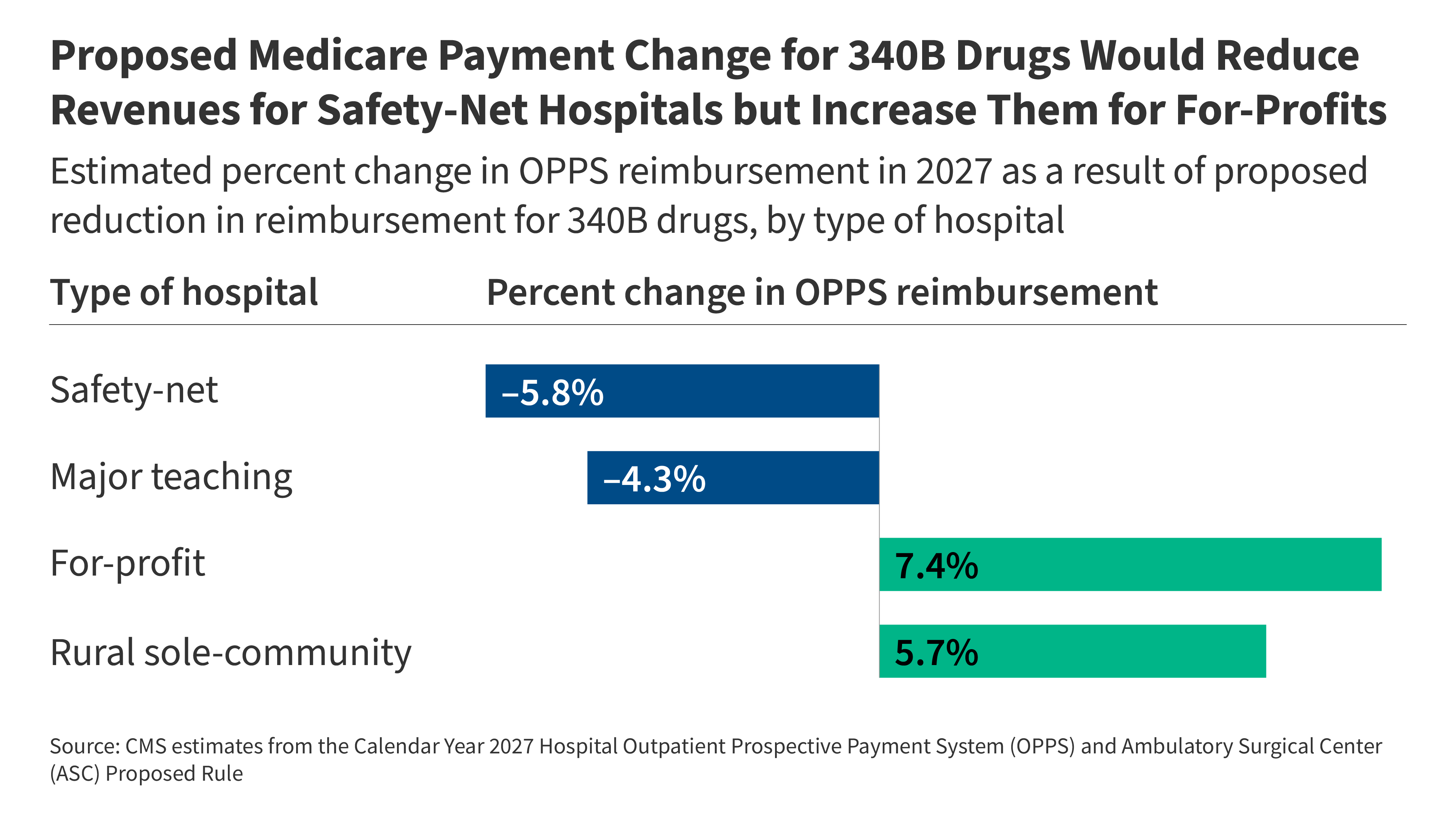
This is not a simple spending cut. It is a redistribution inside hospital outpatient reimbursement, and the source’s main point is the split in winners and losers. KFF says the proposal would reduce revenues among safety-net hospitals while increasing revenues among for-profit hospitals, because lower 340B drug reimbursement would be offset through higher non-drug outpatient payments that flow across the OPPS system, not just to 340B providers.
The practical read is that CMS is using the survey the Supreme Court said it lacked to reopen a policy fight that has always been as much about hospital economics as drug reimbursement mechanics.
For hospitals, payers, and investors, the next watch item is whether this remains intact in the final rule and how aggressively affected providers push back. The likely industry argument is familiar from the source: supporters say 340B spread revenue helps fund care for underserved populations and operations, while critics argue the program is not well targeted and can encourage provider consolidation.
If CMS finalizes the proposal, the pressure point in 2027 will be margin mix, not just Medicare drug payment. Safety-net systems with heavier reliance on 340B economics look exposed. Hospitals that benefit more from the 8.44% non-drug outpatient increase may come out ahead. For broader drug pricing and reimbursement context, see RxInfo.ai.