What happened
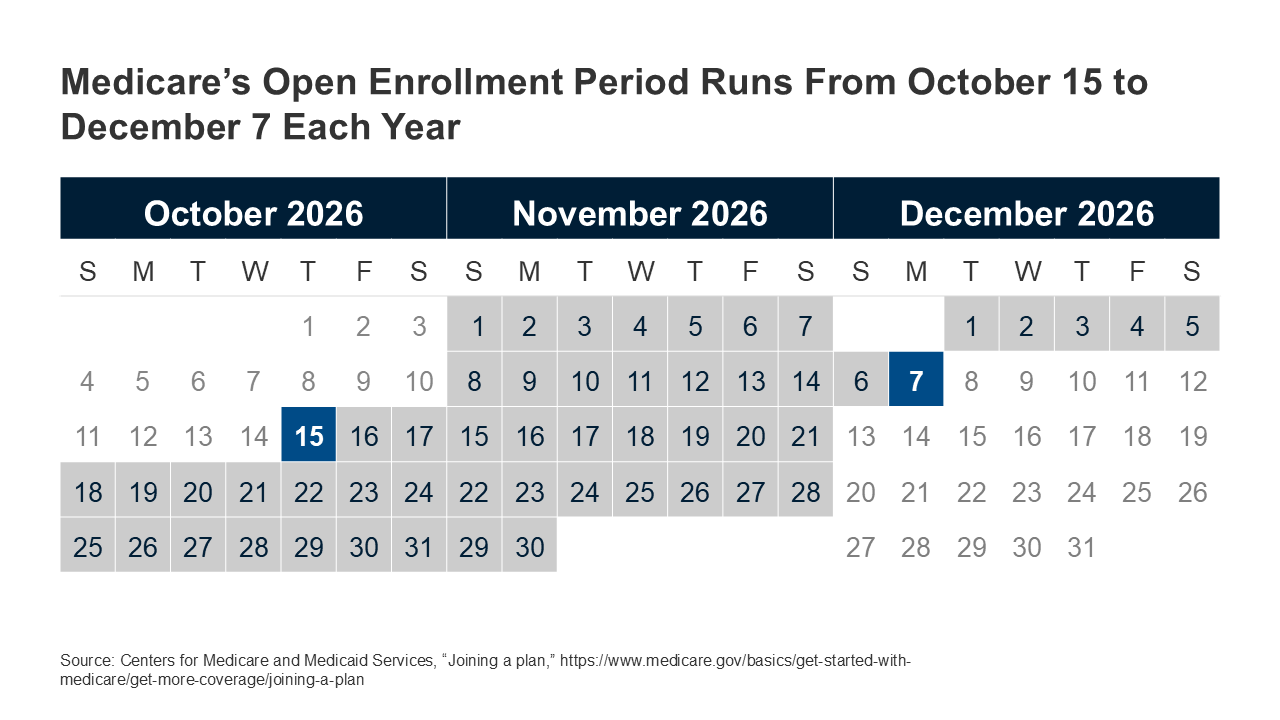
KFF Health News published a Medicare open enrollment explainer on October 9, 2026. It outlines the annual enrollment window, which runs from October 15 to December 7 each year, and says Medicare covers more than 70 million people ages 65 and over and younger adults with long-term disabilities. Beneficiaries can receive coverage through traditional Medicare or a Medicare Advantage plan administered by a private health insurer.
Changes made during open enrollment take effect on January 1 of the following year. Beneficiaries can switch from traditional Medicare to Medicare Advantage or vice versa, move between Medicare Advantage plans, and elect or switch between Medicare Part D prescription drug plans. KFF also notes that people in traditional Medicare can enroll in Part D during this period, potentially facing a late enrollment penalty if they lacked comparable drug coverage. Medicare Advantage enrollees moving back to traditional Medicare can add a Part D plan because outpatient prescription drugs are not covered under Medicare Parts A and B.
Why it matters
The open enrollment season is one of the few fixed points in the Medicare market when member movement can materially reshape plan mix, Part D enrollment, and downstream pharmacy economics. KFF notes that people choosing Medicare Advantage can pick from more than two dozen Medicare Advantage plans on average, and that these plans typically include Part D prescription drug coverage.
The practical implication is direct consumer comparison of plan design, formularies, pharmacy networks, and premium positioning. For PBMs, MA plans, and insurers, this is the annual stress test of whether benefit design actually holds enrollment. For employer-side PBM benchmarking, see RxPBM.ai.
Switching behavior will likely be watched especially closely where beneficiaries are weighing integrated Medicare Advantage drug coverage against traditional Medicare paired with stand-alone Part D and possibly Medigap. KFF’s reminder on late enrollment penalties also matters because friction still influences when and how beneficiaries move.
Investors and plan operators should watch whether plans emphasize simplicity and drug coverage continuity, because those are the decision points most explicitly in play during this October 15 to December 7 window. For readers tracking drug benefit specifics and coverage structure, detailed reference material is at ClinicalRx.ai.